What Is Vinyl Sticker Printing? A Singapore Guide to Waterproof, Die-Cut Stickers
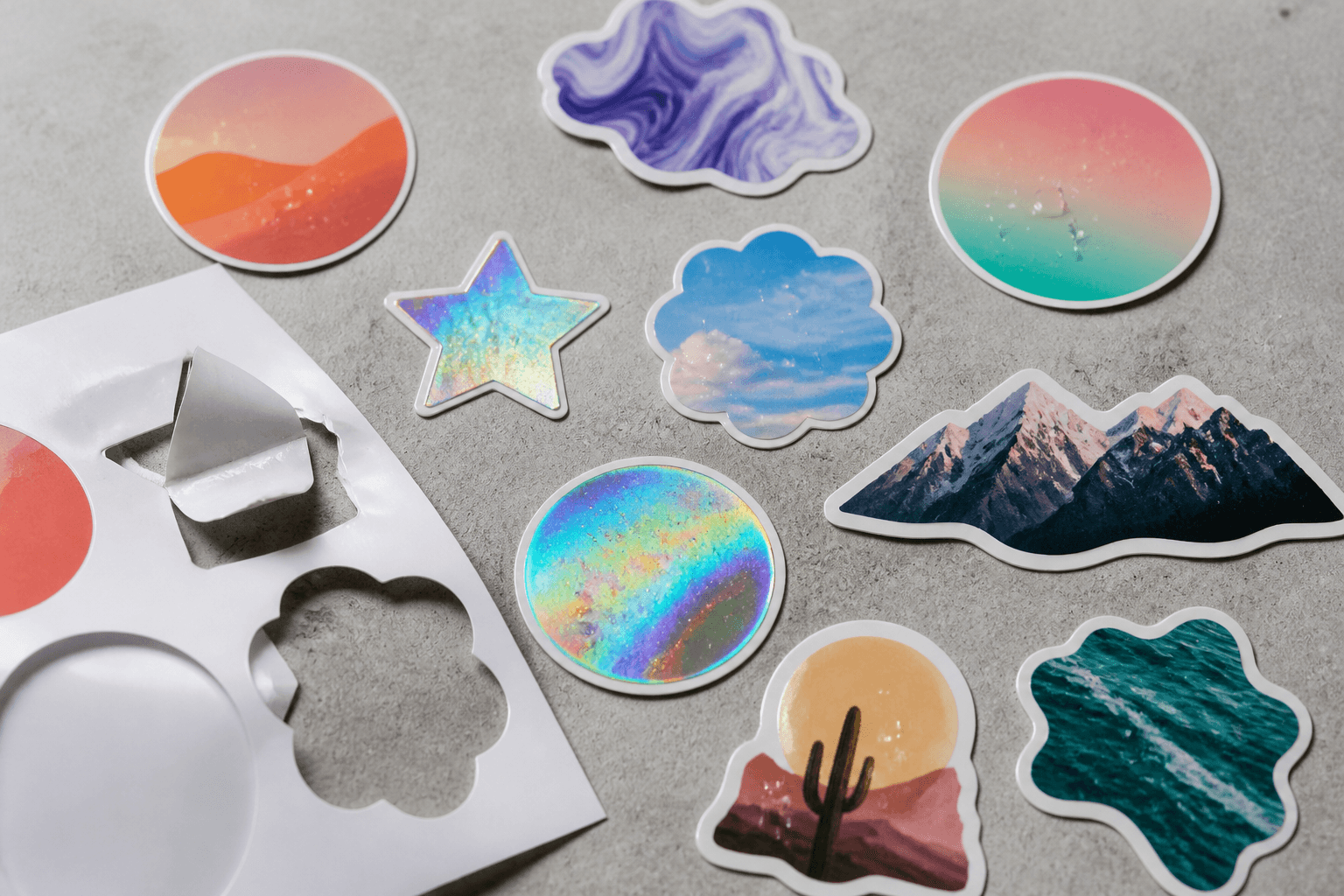
Vinyl sticker printing is full-colour printing on a thin, flexible plastic film rather than paper, so the sticker shrugs off water, bends around curves and survives being handled. When most people in Singapore search for vinyl stickers, what they really want is the result: a waterproof, die-cut sticker that stays put on a laptop, bottle or box. That is exactly what our custom sticker printing in Singapore is set up to deliver, with waterproof Gloss and Matt finishes, a Transparent option and four Metallic effects, all cut to any shape you like.
This guide explains what vinyl actually is, how it compares with paper stickers, the difference between printed and cut vinyl, and how to set up a file so your stickers come out sharp the first time.
What "vinyl" means in sticker printing
In the print trade, "vinyl" usually refers to self-adhesive PVC film: a plastic face layer, an adhesive layer underneath, and a release liner (the backing paper you peel off). Ink is printed onto the face, and the sticker is then cut to shape. Because the face is plastic rather than paper fibre, it does not soak up water or tear when it gets wet.
You will also hear two broad grades of vinyl mentioned:
- Calendered vinyl is rolled out into sheets. It is the everyday workhorse for flat surfaces such as boxes, folders and shop counters.
- Cast vinyl is poured as a liquid and set into a thinner, more conformable film. It is typically chosen for tight curves and long outdoor jobs such as vehicle wraps.
For most product labels, packaging seals, laptop stickers and event giveaways, the grade matters far less than two practical questions: will it handle moisture, and will it be cut cleanly to the shape you need?
Vinyl stickers vs paper stickers
Paper stickers are fine for short-lived, indoor jobs: price tags, envelope seals, one-off event labels. The trade-off is that paper absorbs liquid, scuffs easily and tears when someone tries to peel it off and reposition it.
A plastic-film sticker behaves differently:
- Moisture. Condensation from a cold drink, a quick wipe-down or a rainy walk home does not turn it soft.
- Flexibility. It bends around a water bottle or a curved lid without creasing.
- Handling. It holds up to being carried in bags, stuck on laptops and handled every day.
- Finish. The film can be gloss, matt, clear or metallic, which gives you more creative options than plain paper.
If your sticker is going anywhere near water, a fridge, a kitchen or a bag, you want a waterproof film rather than paper. That is why our waterproof Gloss and Matt finishes are the default pick for most orders.
Printed vinyl vs cut vinyl lettering
This is where a lot of confusion comes from. "Vinyl sticker" can mean two quite different things:
Printed stickers
Your artwork is printed in full colour (CMYK) onto the film, then die-cut around the outline. Photos, gradients, illustrations and multi-colour logos all work. This is what people normally mean by custom stickers, and it is how our stickers are made: printed digitally in CMYK, then die-cut to your shape.
Cut vinyl lettering
Here nothing is printed at all. A plotter cuts letters or simple shapes out of a single-colour sheet, and the waste around them is weeded away. It is common for shopfront window lettering and simple one-colour logos, but it cannot reproduce photos or gradients.
If your design has more than one colour, any shading, or a photo, you want printed stickers.
Choosing a finish for your stickers
Once you have decided on a film sticker, the finish is the next decision. On our sticker page every finish is priced the same per sheet, so you can choose purely on look:
- Gloss (waterproof): bright, punchy colour with a shiny surface. Great for brand stickers, laptop stickers and giveaways.
- Matt (waterproof): a soft, non-reflective surface that reads well under shop lighting and feels premium on packaging.
- Transparent: a clear base, so the surface underneath shows through. Ideal for glass jars, clear bottles and windows. Note that clear film has no white behind the ink, so light colours look see-through; an opaque white underbase is a separate quote.
- Metallic Rainbow Sands, Holographic, Stripes and Gold: eye-catching effects for limited drops, merch and premium packaging seals.
How to set up artwork for vinyl sticker printing
Good stickers start with a clean file. Follow these steps and you avoid most of the problems that slow orders down:
- Work at the exact size. Design one sticker at its real finished size in mm, for example 50 × 50mm or 70 × 40mm.
- Use vector where you can. Supply an Adobe Illustrator (.AI) or SVG file. If your design includes photos, make sure they are print-ready at 300 DPI at the final size.
- Use CMYK colour. Screens show RGB; printers use CMYK inks. Converting early avoids colour surprises.
- Add a die-cut line for custom shapes. For round, irregular or logo-outline stickers, draw the cut line as a vector path in the same file. Squares and rectangles are cut to the dimensions you enter, so no cut line is needed.
- Keep important details away from the edge. Leave a little breathing room between text and the cut line so nothing important gets trimmed.
- Plan white ink separately. If you need white printed on a transparent or metallic sticker, ask for a quote before ordering, as it is not included in the standard price.
Ready to try it? Enter your sticker width and height on the configurator and order your die-cut stickers on the stickers page, where the price and the number of stickers per sheet update live.
How sheet-based sticker printing works
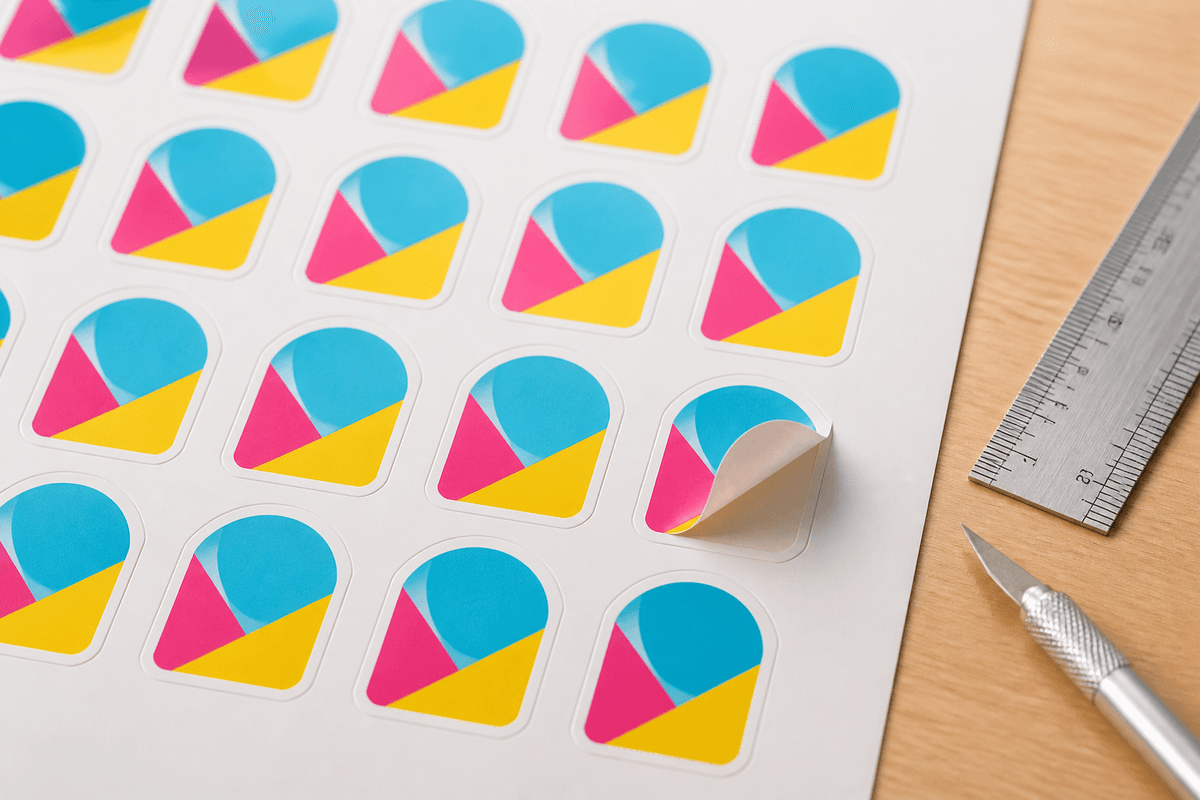
Our stickers are printed on a 320 × 450mm sheet with one design per sheet. You send a single design at one size, and it is laid out as many times as it fits, with a margin around the sheet edge and a small gap between stickers. Smaller stickers mean more per sheet: as a guide, a 50 × 50mm sticker fits 40 per sheet, while an A6 sticker fits 8.
This makes it easy to plan quantities. Work out how many stickers you need, check the yield for your size on the calculator, then choose the number of sheets. If you need several different designs, order each one as its own line.
Common uses for waterproof stickers in Singapore
- Packaging seals and product labels for home bakers, cafés and online shops, where boxes get handled and drinks get cold.
- Laptop and bottle stickers as brand merch or event swag that people actually keep.
- Jar and bottle labels on clear containers, using Transparent film so the product shows through.
- Limited drops and collectibles on Holographic or Gold for something that feels special.
Some jobs need a different product altogether. For branding on hard, smooth surfaces such as glass, metal, wood or plastic, a UV DTF sticker puts your design onto those surfaces with a simple peel and press. For vehicles, a car decal printed on an opaque white base keeps colours bright even on tinted glass.
Frequently asked questions
Are vinyl stickers waterproof?
Plastic-film stickers resist water far better than paper ones because the face does not absorb moisture. On our sticker page, the Gloss and Matt finishes are both waterproof.
What is the difference between vinyl stickers and decals?
The terms overlap. "Decal" often describes larger stickers for windows, walls or vehicles, while "sticker" usually means smaller pieces for products, packaging and giveaways.
Can I print stickers in any shape?
Yes. Our stickers can be round, square, rounded rectangles, the outline of your logo, or irregular shapes, including cut-outs inside the sticker. Just include a vector cut line for anything that is not a plain square or rectangle.
Do I need bleed for sticker artwork?
For our stickers, no bleed is needed. Supply one sticker at its exact size in CMYK, with a die-cut path for custom shapes.
How many stickers do I get per sheet?
It depends on your sticker size. Enter the width and height in mm on the configurator to see the exact count per sheet.
Get the vinyl-sticker result without the guesswork
Vinyl sticker printing is really about durability and shape: a flexible, water-resistant sticker cut cleanly to your design. Pick waterproof Gloss or Matt for everyday branding, Transparent for clear surfaces, or a Metallic finish when you want to stand out. Then send one clean, CMYK, exact-size file with a cut line, and you are set.
Build your design, choose your finish and order on the stickers page, where the live calculator shows your yield and total before you check out.